

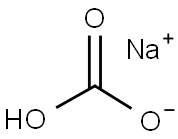
Sodium bicarbonate, which is the compound commonly called baking soda, exists as a white, odorless, crystalline solid. It occurs naturally as the mineral nahcolite, which derives its name from its chemical formula by replacing the “3” in NaHCO3 with the ending “lite.” The world’s main source of nahcolite is the Piceance Creek Basin in western Colorado, which is part of the larger Green River formation. Sodium bicarbonate is extracted using solution mining by pumping hot water through injection wells to dissolve the nahcolite from the Eocene beds where it occurs 1,500 to 2,000 feet below the surface. The dissolved sodium bicarbonate is pumped to the surface where it is treated to recover NaHCO3 from solution. Sodium bicarbonate can also be produced from the trona deposits, which is a source of sodium carbonates (see Sodium Carbonate).Sodium bicarbonate, used in the formof baking soda and baking powder, is the most common leavening agent. When baking soda,which is an alkaline substance, is added to a mix, it reacts with an acid ingredient to producecarbon dioxide.
|
Synonyms: 6-[(2-carboxy-4,5-dihydroxy-6-methoxy-3-oxanyl)oxy]-4,5-dihydroxy-3-methoxy-2-oxanecarboxylic acid;Alginic Acid Sodium Salt, Technical Grade;hzsn;CuringBon;Sodium alginate, AR,90%;Alginate Sodium;FEMA 2015;Alginicacidsodiumsalt,lowviscosity CAS: 9005-38-3 MF: C5H7O4COONa MW: 0 EINECS: 618-415-6 Product Categories: Anionic Surfactants;Carbohydrates;Carbohydrates and Starches;Fucus vesiculosus;Functional Foods;Materials Science;Food additives;Natural Polymers;Nutrition Research;Phytochemicals by Plant (Food/Spice/Herb);Polymer Additives;Polymer Science;stabilizer;As a thickener, stabilizer, emulsifier, a large number of applications in food industry;Polymers;Polysaccharide;Surfactants;bc0001;9005-38-3 Mol File: Mol File |
|
|
|